

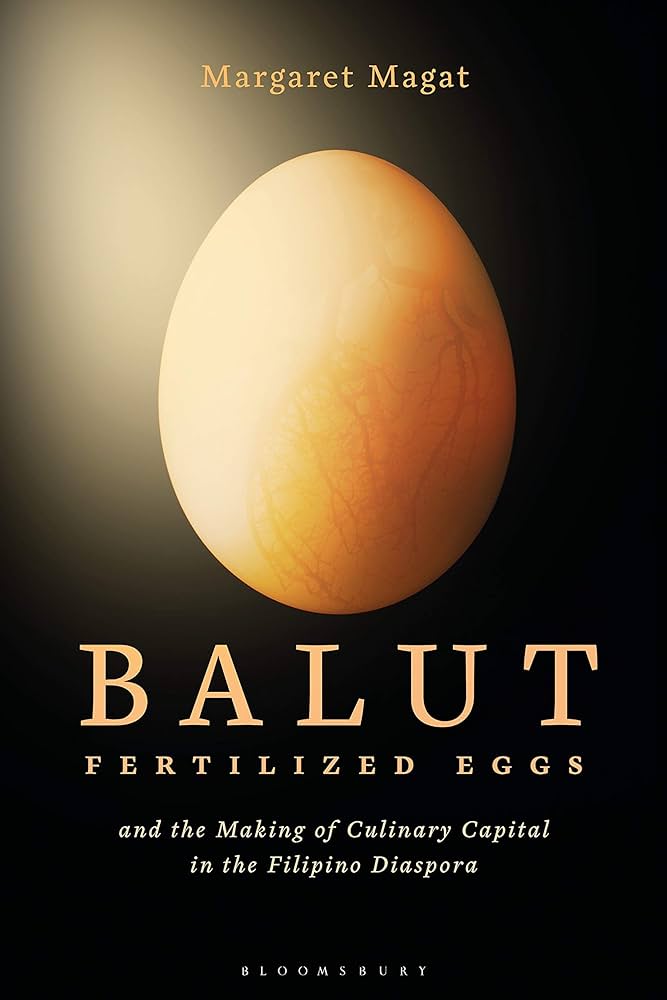
In this book, Margaret Magat discusses how the Filipino delicacy balut, or cooked fertilized egg, has become a popular symbol of Filipino culinary culture and the Filipino diaspora.
The first meeting of the CUHK Philippine Studies Reading Group discussed Margaret Magat’s monograph on a well-known Filipino street food, the fertilized duck egg called balut. In the book, examines balut through multiple perspectives – its production and economy, its ties to Filipino diaspora and nationhood, its links to Filipino folklore, its nature as a form of “culinary capital” tied to the public performance of its consumption through eating contests, and its ubiquity among different forms of media from reality television to online videos. Primarily rooted in the field of folklore studies, Magat’s work shows how a food item can have multiple impacts across different contexts and groups and made for an interesting point of discussion among the reading group with regards to how Philippine studies can go beyond the Filipino people and also focus on products that were the result of the Filipino diaspora.
One of the main themes discussed by the group was the idea of authentic balut. While Magat makes it clear that cooked fertilized poultry eggs are common in Southeast Asia, such as hot vit lon in Vietnam and pong tia koon in Cambodia (2021:1), to a much global audience, and in particular in the United States where Magat situates most of her research, the dish is most commonly associated with the Filipino people. While balut production and consumption is very much alive and well in the Philippines, it is economically viable to ship Philippine-made balut to the United States, and thus most of its local balut production are actually from Vietnamese duck farms. Is the authenticity of the balut intact throughout this outsourced process? Magat argues that while authenticity is a “constructed illusion” (2021:4), balut can be as close as one can get to an authentic dish due to the simplicity of the dish – a balut is simply a cooked fertilized duck egg, regardless of who cooks eat.
However, the question of authenticity, particularly as it relates to Filipino identity, goes beyond the production of the balut, and is more visible in its consumption. One of the other key points raised by the group is how motivations for the consumption of balut differ between the local Philippine and diasporic contexts. While those in the Philippines consume balut for a mixture of different reasons, such as appetite, nourishment, and even the performance of masculinity, Magat’s work shows that for those in the diaspora, balut consumption is often tied to the performance of a Filipino identity. Thus, while those in the Philippines might have not thought of balut eating as something that “makes them Filipino”, for those in the diaspora, this may actually be the case. In fact, Magat’s chapter on balut eating contests shows how people who may not be ethnically Filipino may be conferred the “honorary Filipino” status by being able to garner culinary capital by eating balut. Going beyond the example of balut, this points to a wider concern in Philippine studies – there is often quite a strong link that is put between local Filipinos and diasporic Filipinos, when in fact as this book illustrates the two groups have distinct differences. While there is the common historical core that binds the two, diasporic Filipinos need to be understood more in the context of their respective host societies, and how their being Filipino contributes to their experiences as diasporans, not just as a marker of their ethnic identity.
Finally, the group also pointed out that Magat’s multi-perspective approach made for a good way to analyze a subject like balut, as focusing on only one particular aspect, such as production, would have made for a more limited discussion. Despite that, the group also felt that there could have been more written on some sections than others. For instance, while the sections on the supernatural that talked about aswangs made for an interesting read, it felt rather tangential to the topic of balut, while the section on balut farms in the United States could have been expanded. Related to this was also how the historical sections of the book were written; with the focus being more on how Filipino foodways such as balut were introduced into the islands and not much with how the islands itself also had their own developed food cultures before the arrival of Spanish and American colonizers. The members of the reading group from the Department of History commented on how this was common in American historiography, which is often the main source that books published in the US interact with.
Overall, the first meeting of the reading group proved to be a successful one, setting the way that future discussions would be carried out. Balut: Fertilized Eggs and the Making of Culinary Capital in the Filipino Diaspora was a good starting book to discuss the issues of scholarship on Filipinos. As the reading group is primarily made up of Filipino scholars who were all born and raised in the Philippines and were all up until their graduate studies in the Chinese University of Hong Kong trained and conducted their studies in the Philippines, it was interesting to go through the work of a diasporic Filipino scholar and see how different the perspectives were. The group hopes to expound further on this notion in its succeeding meetings.
 CUHK Philippine Studies Interdisciplinary Reading Group
Leave a comment