

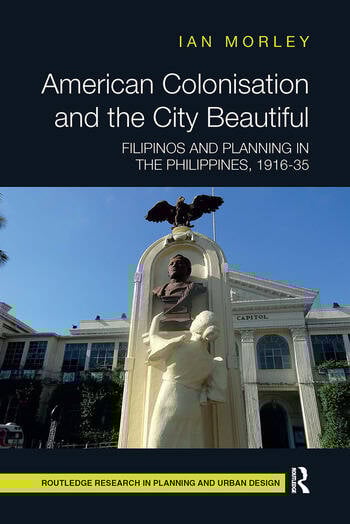
Ian Morley’s American Colonisation and the City Beautiful delves into the fascinating history of urban planning in the Philippines during the American colonial period, specifically between 1916 and 1935. This period marked a shift in governance, with urban planning becoming a means of exerting influence through the City Beautiful movement, an American concept that sought to promote civic pride and social harmony through grand, orderly urban design. Morley’s work offers a nuanced perspective on this transformation by highlighting Filipino agency and participation in urban planning. This book is a vital addition to the field of Philippine urban historiography, filling in significant gaps concerning the architectural and planning contributions of Filipinos under American colonial rule.
Morley’s book examines how city planning initiatives in the Philippines reflected broader American imperial ambitions. The author explores how the Bureau of Public Works (BPW), through its Division of Architecture, facilitated the development of Philippine cities in ways that mirrored the City Beautiful principles popular in American urban design. However, what makes Morley’s study unique is his focus on cities like Tayabas and Iloilo, deviating from the more commonly studied Manila and Baguio, thereby broadening the geographical focus and allowing for a richer understanding of Filipino urban identity during this era.
A significant aspect of Morley’s work is his revision of prior colonial-era scholarship, which often ignored the role of Filipinos in city planning. He provides insights on how Filipino planners and architects, many of whom trained in the United States as “pensionados” (scholarship students), were instrumental in shaping Philippine cities. This involvement suggests a “Filipinization” of the City Beautiful, revealing the emergence of a uniquely Filipino interpretation of these urban planning ideals.
One of the primary topics in our reading group was the concept of urban beauty. Morley suggests that for American planners, urban beauty was not merely an aesthetic pursuit but a psychological one aimed at fostering a sense of place and pride. This psychological aspect resonated strongly in the Filipino context, where the aesthetics of urban space became a point of cultural exchange and adaptation. The discussion in our group emphasized how Morley’s work brings out the unique Filipino interpretation of beauty within the colonial framework, where urban design became an avenue for both cultural assertion and adaptation.
The group also discussed modernization and assimilation, key themes in Morley’s study. Unlike the Spanish, whose urban designs were more pragmatic and less interventionist, American city planning was deeply ideological, intending to inculcate “modern” values in Philippine society. Morley effectively illustrates how urban planning became a tool for assimilation, though his work also points to the nuanced Filipino responses to this strategy. This aspect of the discussion raised questions about how the City Beautiful movement served to impose an American modernity that was selectively adopted and reshaped by Filipino planners.
A particularly engaging part of our discussion focused on the contrasting urban planning philosophies of American and Spanish colonial powers in the Philippines. Morley’s book highlights a notable shift: where the Spanish had a more restrained approach, American planners aimed for a broader transformation, envisioning Filipino cities as showcases of American civic ideals. His study offers a detailed look at how these ideals shaped city layout and infrastructure, turning them into emblems of an imposed modernity, which our group found both enlightening and provocative.
Morley’s exploration of the City Beautiful movement in the Philippines was also a key discussion point. This movement, originating in the United States, emphasized symmetry, grandeur, and green spaces, seeking to “beautify” urban environments as a means to improve social order. In the Philippine setting, Morley traces how these grand zoning plans impacted local city design, producing a blend of American ambition and Filipino aesthetic sensibilities. The group reflected on how the ideals of the City Beautiful found a receptive, yet innovative, audience among Filipino planners who saw in it the potential for an urban identity that transcended colonial narratives.
A valuable contribution of Morley’s work is his reconsideration of Filipino involvement in city planning after 1916, an aspect often neglected in previous studies. By documenting the active roles played by Filipino architects and planners within the BPW, especially the influence of pensionados, Morley fills an important gap in our understanding of colonial urban planning. Our reading group agreed that this “Filipino City Beautiful” was a powerful assertion of identity, one that allowed Filipinos to redefine their cities while still working within the parameters of American-imposed plans.
Morley’s book made me reconsider some of my own perspectives on urban history. His book provided valuable context for my research on the representations of Tondo in English newspapers during the American colonial period. His focus on Filipinization and the role of Filipino planners in urban development deepened my understanding of the broader social and political frameworks within which the representations were crafted.
While my study centers on the portrayal of Tondo rather than direct urban planning practices, Morley’s concept of a “Filipino City Beautiful” offered useful insights into how American civic ideals were imposed and adapted in Filipino urban spaces. This perspective helps me critically examine how colonial narratives in the press might reflect or distort the evolving identity of Manila’s neighborhoods and how urban planning themes influenced public perceptions of the time.
Another intriguing aspect was the influence of pensionados in the BPW. This brought up questions about the complex identities of Filipino planners, who, while influenced by American education, sought ways to incorporate local ideals and aesthetics into their work. This nuanced view of colonial agency is something I hope to explore further in my research.
In American Colonisation and the City Beautiful, Ian Morley provides a fresh, insightful perspective on Philippine urban planning history. By bringing Filipino voices and actions to the forefront, he redefines the colonial narrative, emphasizing collaboration and adaptation rather than mere imposition. For those interested in colonial urban planning, Southeast Asian history, or the evolution of the Philippine built environment, Morley’s work is essential reading. His contributions to Philippine urban historiography offer a model of interdisciplinary research that underscores the complex interplay between power, identity, and place.
 CUHK Philippine Studies Interdisciplinary Reading Group
Leave a comment