

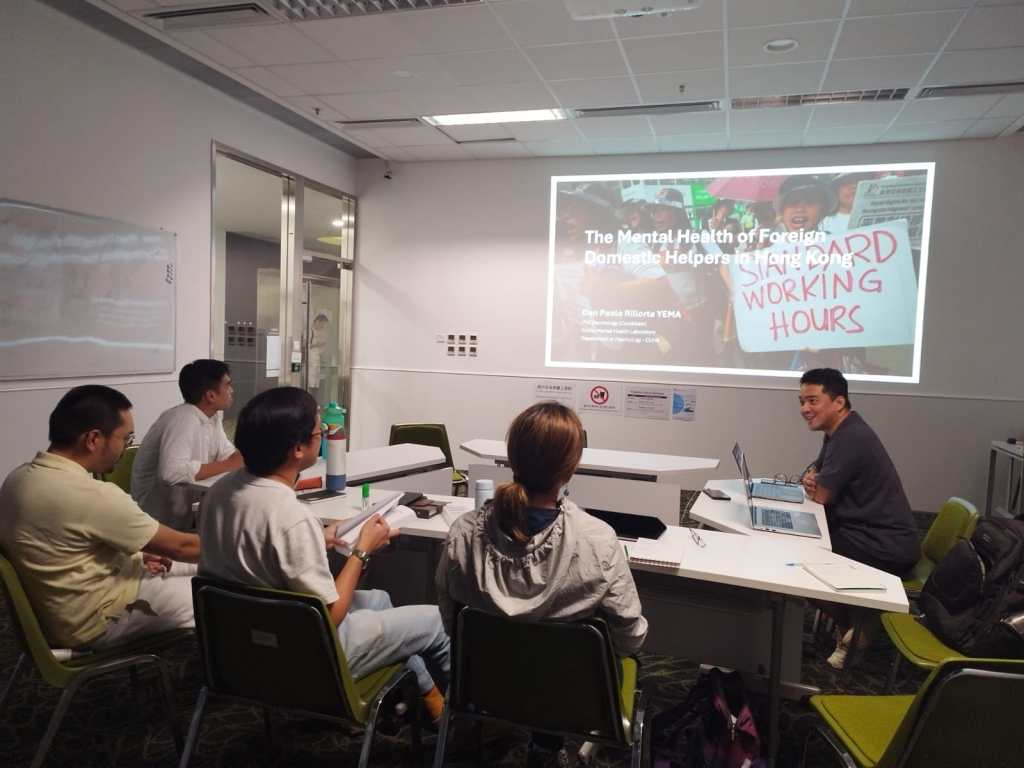
Our reading group kicked off its first session on October 17, 2024, at CUHK’s Learning Commons, Group Study Room 1, Wu Ho Man Yuen Building. It was facilitated by Donna Rebong and Dan Yema. Both presented general information about their books and discussed how they used these to develop their ongoing dissertation research.
Donna started with Disability and Social Theory: New Developments and Directions, an edited collection by prominent disability scholars Dan Goodley, Bill Hughes, and Lennard Davis. Her presentation highlighted Critical Disability Studies (CDS) perspectives, particularly how Bill Hughes connects Norbert Elias’s civilizing process theory to the management of disability, as well as Shaun Grech’s approach to viewing colonialism through the lens of disability. Donna explored how these frameworks can be applied to the history of disability management during the American colonial period in the Philippines.
After the presentation, group members raised their questions which varied from the manifestations of eugenic movements in the Philippines in the early twentieth century, the application of CDS in understanding the intersection of disability with gender, to the notion of “Filipinized” disability management in the latter part of American colonization of the Philippines when the Philippine colonial bureaucracy was Filipinized with the enactment of the 1916 Jones Act. Read Donna’s book review here.
On the other hand, Dan presented Maid to Order in Hong Kong: Stories of Migrant Workers by Nicole Constable. His discussion focused on the mental health struggles faced by migrant domestic workers (MDWs) in Hong Kong, revealing stressors like isolation, work-related pressures, financial constraints, and various forms of exploitation. Dan added depth to the conversation with recent literature and insights from his own research, where he has examined mental health outcomes and coping strategies among Filipino domestic workers in Hong Kong. This sparked a lively exchange on how social networks, religious engagement, and support organizations like the Mission for Migrant Workers (MFMW) provide critical relief.
Group members also raised questions about the role of employers, the responsibilities of the state under labor export policies, and potential interventions to improve the work-life balance of MDWs. Read Dan’s book review here.
Our session wrapped up with a strong sense of connection between disability and migration studies, hinting at the broader social structures and policies shaping these experiences. It was an insightful start to our reading group journey, and we’re looking forward to more discussions that challenge and inspire.
 CUHK Philippine Studies Interdisciplinary Reading Group
Leave a comment