

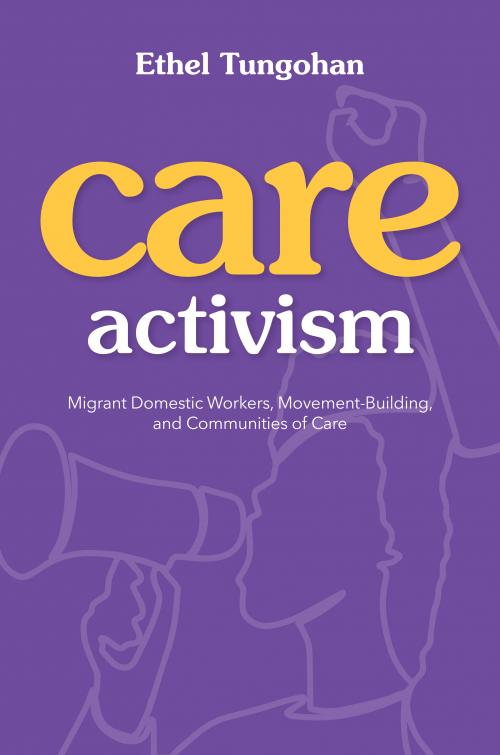
What drives political organizations such as those who fight for migrant workers’ rights to bear the uphill battle towards political reform? In Care Activism, Ethel Tungohan argues that the key to answering this question is remembering that at its core, these organizations are made of people who, at the end of the day, care about other people. For Tungohan, care is central to understanding the dynamics of activism and political movements. Based on her fieldwork among migrant workers’ groups in Canada, Hong Kong, Singapore, and the Philippines, Tungohan shows how these groups can become significant agents of change, reshaping both local and global discourse on migrant workers’ rights. Her interviews with leaders of these organizations show how despite any differences in ideology among organizations, what connects them all is a capacity for care; a drive to ensure the well-being of all current and future migrant workers, informed and powered by the struggles and experiences of those who came before. Her ethnographic accounts show that beyond the more visible political actions, everyday care activism can be found in the myriad ways in which migrant workers care for members of their community, in acts of caremaking among transnational families, kinships, and friendships.
The book was discussed by reading group member Jad De Guzman, who then posed the following discussion question among the group: How does the concept of care appear in your research area? The interdisciplinary character of the reading group gave way to an interesting set of answers. Aileen Del Rosario-Rondilla, whose doctoral dissertation looks into gender and business among business families in the Philippines, located care within the enterprise. While Human Resources is generally tasked with what we could consider the business’ responsibility of care to employees, particularly with the legally-mandated rights that workers enjoy, Aileen also brought up that in a lot of offices, management can go beyond these, providing food or gifts to employees on certain occasions. To what extent are these acts considered care, or as mere performative attempts to increase worker morale?
The historians among the group shared various ways in which care could be interpreted from historical records. Jio Guiang, currently working on his master’s thesis on Filipino pensionados during the American colonial period, shared that while it was difficult to find direct mentions of care in his work, unless one considers how pensionados were housed by American families during their studies, what does resonate with Tungohan’s work is how even during then, migrants had to find solace and support among themselves. Faced with increased racial tensions following the economic impacts of the Great Depression, Filipinos, along with other immigrants, relied on migrant communities to support each other. Studying disability during the same period, Donna Rebong shared how the society of Freemasons helped foster communities of care that extended help to persons with disabilities, by establishing the Masonic Hospital for the Crippled in the late 1920s, laying the foundation for a Filipino-led disability management at the fringe of US colonial rule.
Dan Yema, whose work deals with stepped-care mental health programs for migrant domestic workers, shared that his current work shows that there is much to improve in terms of providing access to mental health services. While his work is more focused on identifying the challenges to improve access and testing possible interventions, he hopes his work will eventually be used to build upon policy changes. Communities of care can be expressed through interventions such as peer counseling and support groups, which are an important part of the stepped-care model.
Lastly, Will Gonzales, assistant professor of applied English linguistics at CUHK, expressed his interest in the sociolinguistics of care and communities of care. What words and turns of phrases are used in the discourse of care, and how does this shape the way care is expressed? For example, Jad mentioned that in his fieldwork, domestic workers often refer to food shared during Sundays as ayuda, a term that gained popular use in the Philippines during the COVID-19 pandemic, when both government and private efforts sent out relief packages to people.
Overall, Tungohan’s Care Activism led to an interesting discussion on the nature of care and how it is expressed and practiced. Filipinos have a reputation for being one of the world’s most hospitable cultures – to what extent is this reflected (and possibly reinforced) in literature on Philippine studies? Because care is such a core activity of human interaction and society, it is important to center it around interdisciplinary discussions, as it shows us the different possibilities that we can consider this concept across various fields. Care on its own might seem inconsequential, but as Tungohan argues, it is care, along with other affective forces, that fuel the fight towards change.
Tungohan, Ethel. 2023. Care Activism: Migrant Domestic Workers, Movement-Building, and Communities of Care. USA: University of Illinois Press. Paperback: 208 pages.
 CUHK Philippine Studies Interdisciplinary Reading Group
Leave a comment