

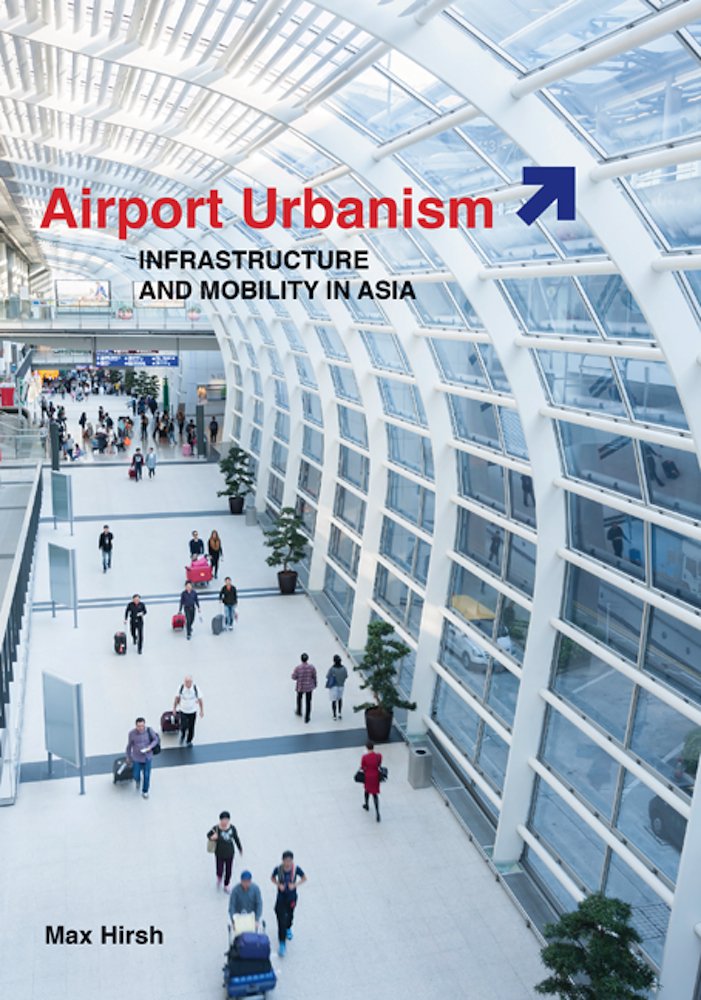
Max Hirsh, a leading expert on airports and urban development, coined and operationalized the term airport urbanism. According to Hirsh, it is a “people-focused approach in designing airports and planning urban developments around the airport. It highlights the desires and needs of people who use the airport on a regular basis such as passengers, employees, and local residents. Lastly, the concept advances development strategies that deliver long-term benefits to both the airport and the city that it serves. In the book, Hirsh operationalized this concept by problematizing the relationship between the rapid growth of low-cost aeromobility and the urban development in five major Asian cities: Hong Kong, Shenzhen, Singapore, Kuala Lumpur, and Bangkok. Through these selected case studies, Hirsh investigates how aeromobility affects Asian urbanism, specifically the [seemingly] hidden networks that facilitate movement over iconic infrastructures and jet-setting global elites.
During the session, this central argument by Hirsh became one of the main points discussed by the members: airport terminals designed for the corporate and business elites “are ill-equipped to handle the rise of low-cost air travelers.” Since most of us have experienced the services of low-cost/budget carriers in the Philippines such as Cebu Pacific and Air Asia Philippines, we were able to relate to this disjunctive misalignment of infrastructure visions and the actual experiences/statistics of passengers. For instance, while there is nothing inherently wrong when it comes to spatial improvement of airports, it is evident that majority of international airports in the Philippines overlook the simple fact that majority of its passengers are overseas Filipino workers (OFWs). To understand the dynamics of their sojourn from their home country to their host country (and vice-versa) means to realize the different travel patterns and attitudes of these specific group of passengers. For example, it is vital to recognize that these OFWs have more baggage (in a literal and a figurative sense) than a typical passenger who leaves the country for leisure or business function. These seemingly trivial and minute details become significant when the current airport flows (operations) are confronted by the exponential number of such passengers. In a sense, Hirsh is correct in stating that airport designs have to be more people-focused, and in the case of the Philippines, it has to attend to the usual users of airports.
Another point that was raised by the group was the relationship between the city and the main airport servicing that city. While a number of scholarship has delved into how airports are cities or how cities emerge from an airport (and vice-versa), the discussion shifted into problematizing how an airport dictates the urban development of a city, and at the same time, the city also dictates any form of progress that transforms its airport. We have concluded that it is pointless to fixate on improving the efficiency of one over the other because the improvement of these two sites are mutually and directly dependent with each other. For instance, it is useless to expand and append larger passenger terminals if the airport cannot construct a new runway that can service more aircrafts. The flows are still constricted in a way that the bottlenecks are just redistributed elsewhere. Moreover, if the flows within the cities are inefficient, it will definitely affect the movements within airports. The assemblage of airport spaces are dictated by the various fragments and aspects of the city that can be considered as appendages.
It is interesting to note that critical discussions of airport spaces are frequently overlooked. Most of the time, these infrastructures are regarded as trivial and common, not worthy of extended analysis. However, as evidenced by this reading session, almost everyone has something to say when it becomes the focus of the conversation. The experiences, no matter how superficial, when embedded within the larger fabric of an airport’s spatial culture, become significant fragments of insights that can be collectively structured and organized to construct a more nuanced understanding of this liminal space. Ultimately, these forms of dialogues are important in unpacking the overlooked scholarship of airport studies from “invisibility” to “in visibility”.


Leave a Reply