

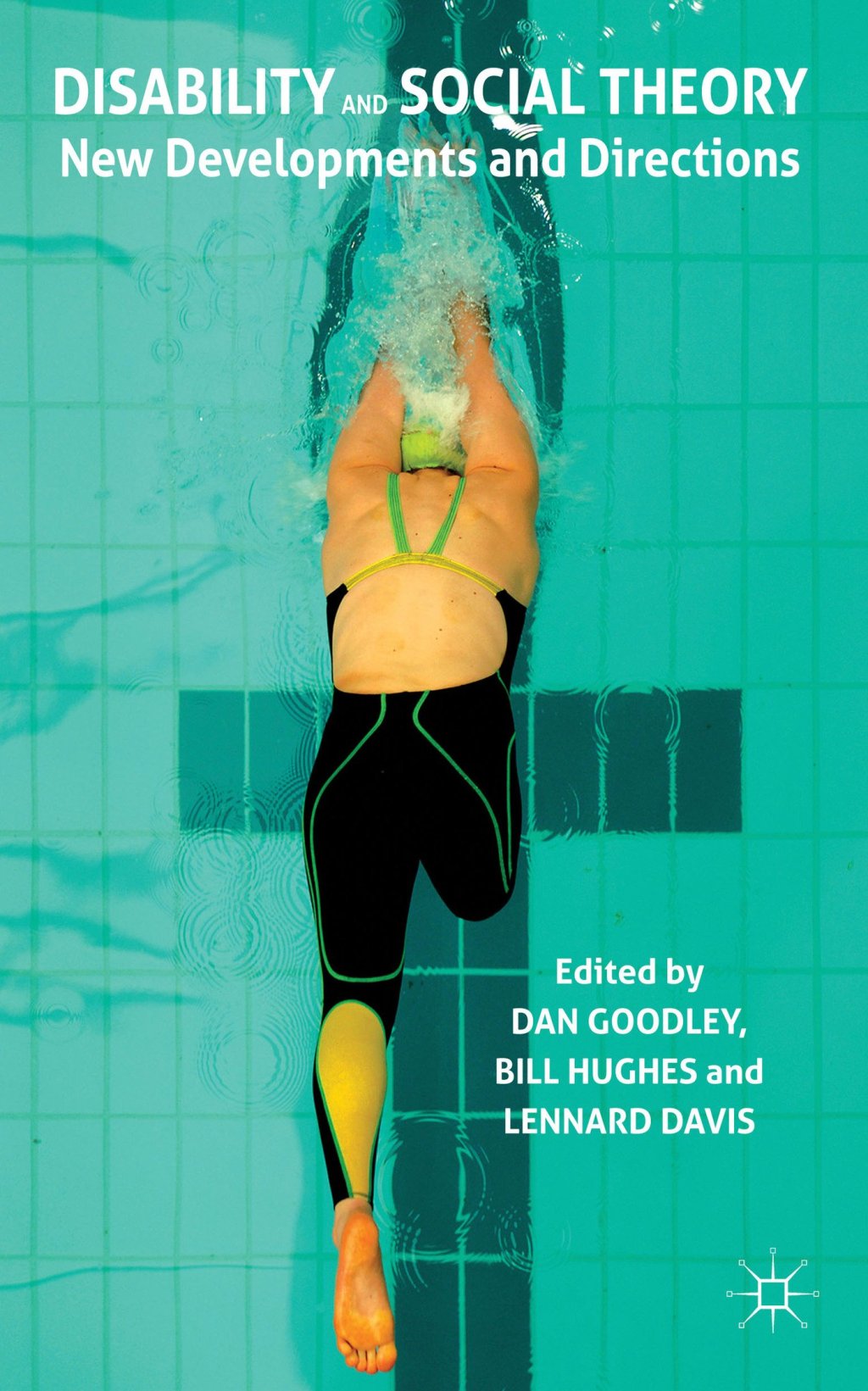
Disability and Social Theory: New Developments and Directions is an edited volume of various articles on the emerging theoretical approaches on disability research published by Palgrave Macmillan in 2012. Dan Goodley, Bill Hughes, and Lennard Davis who serve as the editors are all known disability scholars. Aside from them, there were 23 contributors to this book who came from different sectors, such as the academe, disabled people’s organizations, and non-government organizations.
The book has 18 chapters and four major sections. The first major section focuses on culture and how disability is constituted through it by “reconceptualizing disabled bodies and minds as social sites of power, language, discourse, and action.” The second major section deals with the conceptualization of the body not only as a biological and cultural entity but as “a complex site for the (re)constitution of culture, technology, performance and of life itself.” The third section explores disability as subjectivities, and questions the notion of the normative subject about disabled bodies, and provides alternative modes of being and becoming. The fourth section interrogates the relevance of theories developed by Critical Disability Studies in understanding disability in different spaces, such as institutional, national, and supranational.
According to the editors, the book has the following objectives: 1) “to further examine social theory and disability as resources for thought, action and activism;” 2) “to invite contributors from a broad range of social sciences and ask them to inject their chosen theoretical perspectives into disability studies;” 3) “to capture a number of theoretical interventions that are committed to the politics of disability in the hope that theory and praxis can be seen as interrelated;” and 4) “to provide a sustained and coherent analysis of critical disability studies about a host of disciplines and emerging theories, including perspectives from psychology, psychoanalysis, education, social and critical pedagogy, community work, sociology, philosophy, geography, critical race, development and women’s studies.”
This edited volume, which locates its contribution within the newly developed sub-discipline of Critical Disability Studies (CDS), is relevant as it reiterates the need to advance social theories in Disability Studies outside the scholarly tradition of the social model of disability. It underscores the connections of Disability Studies with other disciplines in the Humanities and Social Sciences and the necessity to develop CDS further to better understand the intersection of disability with poverty, gender, age, ethnicity, sexuality, and national location.
Goodley, D., Hughes, B., & Davis, L. J. (2012). Disability and social theory : new developments and directions. Palgrave Macmillan.
 CUHK Philippine Studies Interdisciplinary Reading Group
Leave a reply to First Reading Group Session Recap – CUHK Philippine Studies Interdisciplinary Reading Group Cancel reply